From Field Sketch to Studio Canvas: How War Art Gets Made
There is usually a thirty-year gap in the middle of a veteran's painting. On one side: a pencil sketch on damp paper, a few photographs, letters home. On the other: a finished canvas in a spare-room studio, painted by a steadier hand with greyer hair. This page walks through that gap — the working method by which Vietnam-era memory becomes paint, and what collectors and families should understand about the objects that result.
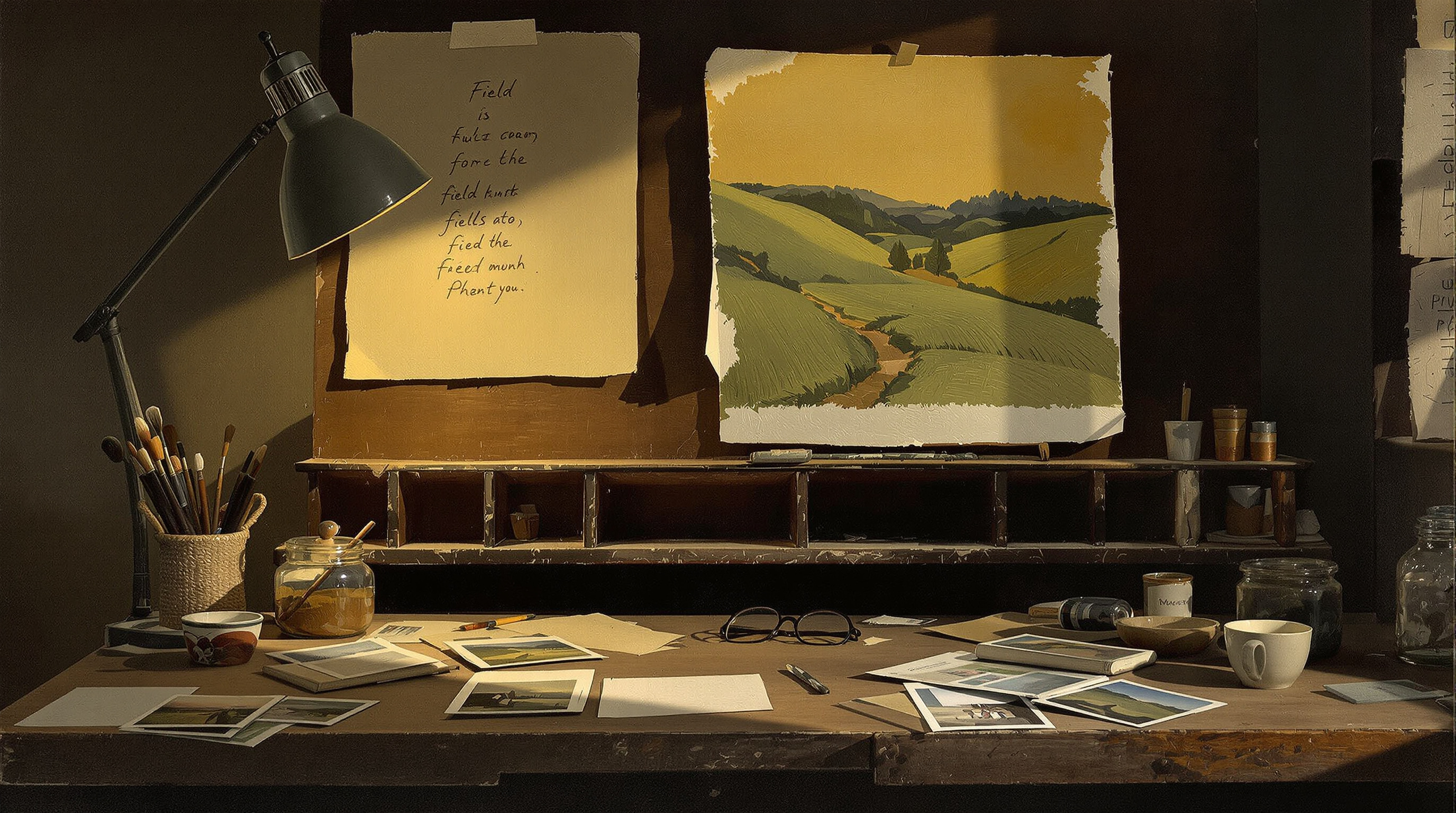
The Source Material
Almost every veteran painter works from a private archive: snapshots from a cheap camera, a buddy's slides, the unit's cruise book, and — most precious — anything drawn in country. A margin sketch has authority no photograph carries, because it records what the eye chose under pressure. Official records fill the gaps; unit command chronologies and after-action reports, many now digitized by the U.S. National Archives, let a painter confirm that the road really did bend that way, that the hill really was numbered what memory insists.
Memory as a Medium
Painters in this genre describe memory behaving like watercolour: some passages fixed and vivid, others dissolved entirely. The honest method paints both — rendering the remembered things sharply (the texture of sandbags, the exact green of the paddy at a certain hour) and letting the forgotten things stay soft. Much of the genre's emotional power lives in that selective focus. A canvas uniformly detailed, edge to edge, usually means the painter worked from photographs alone; a canvas with islands of intense precision in a sea of wash is the signature of memory doing the drawing.
The Studio Decades Later
The technical path is ordinary — graphite studies, a value sketch, underpainting, glazes — but the sequence is emotionally loaded in ways studio manuals never cover. Many veteran artists report that certain passages can only be attempted in short sessions; some paintings stall for years at the same square foot. Families should know this is normal to the genre. The unfinished canvas in the garage is not abandoned; it is waiting.
What the Finished Work Is For
Very little Vietnam veteran art was made for the market. It was made for the wall of a den, for a reunion raffle, for the family of a man who did not come home, for the painter's own sleep. That origin shapes how the work should be treated now:
- Document everything. Title, place, date, unit context, the painter's own words — record them while the painter can still tell you. The art's meaning is half oral history.
- Keep studies with paintings. A field sketch and its later canvas are one object in two parts; separating them halves the value of each.
- Think archivally. Acid-free backing, UV glass, and stable humidity cost little against what these objects carry. The Smithsonian's collection-care guides are a fine starting point for households, not just museums.
Return to the combat art overview, or read how the early web gave this genre its first public gallery in the Pointman pages.
When the Painting Is Also Repair
It would be dishonest to write about this genre and skip what many of its painters say plainly: the work is not only remembrance, it is repair. Putting a remembered morning onto canvas — slowly, over years — is for some veterans a way of handling images that will not otherwise sit still. The practice is taken seriously enough that national programs now pair working artists with veterans; the National Endowment for the Arts' Creative Forces initiative is among the best known. This does not make every veteran painting a clinical exercise — most are simply pictures. But it explains the peculiar patience the genre demands, and why families should never rush a painter's process.
Where to See the Genre
Beyond the service collections, veteran art surfaces where veterans gather: reunion exhibits, county fairs, VFW and Legion halls, and the small museums of garrison towns. It is worth seeking out in person. Reproduction flattens this work more than most, because so much of its meaning is in scale and surface — the canvas a man stretched himself, the corrections visible under the glaze. If a show comes within a tank of gas, go.