A Collector's Guide to Art Cards & Edition Prints
This page was once an order form. It listed every image in the gallery in three or four formats — the five-by-seven card, the eight-by-ten frameable print, the eleven-by-seventeen, the sixteen-by-twenty limited edition — with prices that now read like a postcard from another economy. We have kept the page and changed its job: instead of taking orders, it explains the formats themselves, because the small vocabulary of editioned art still confuses more buyers than anything else in a gallery.
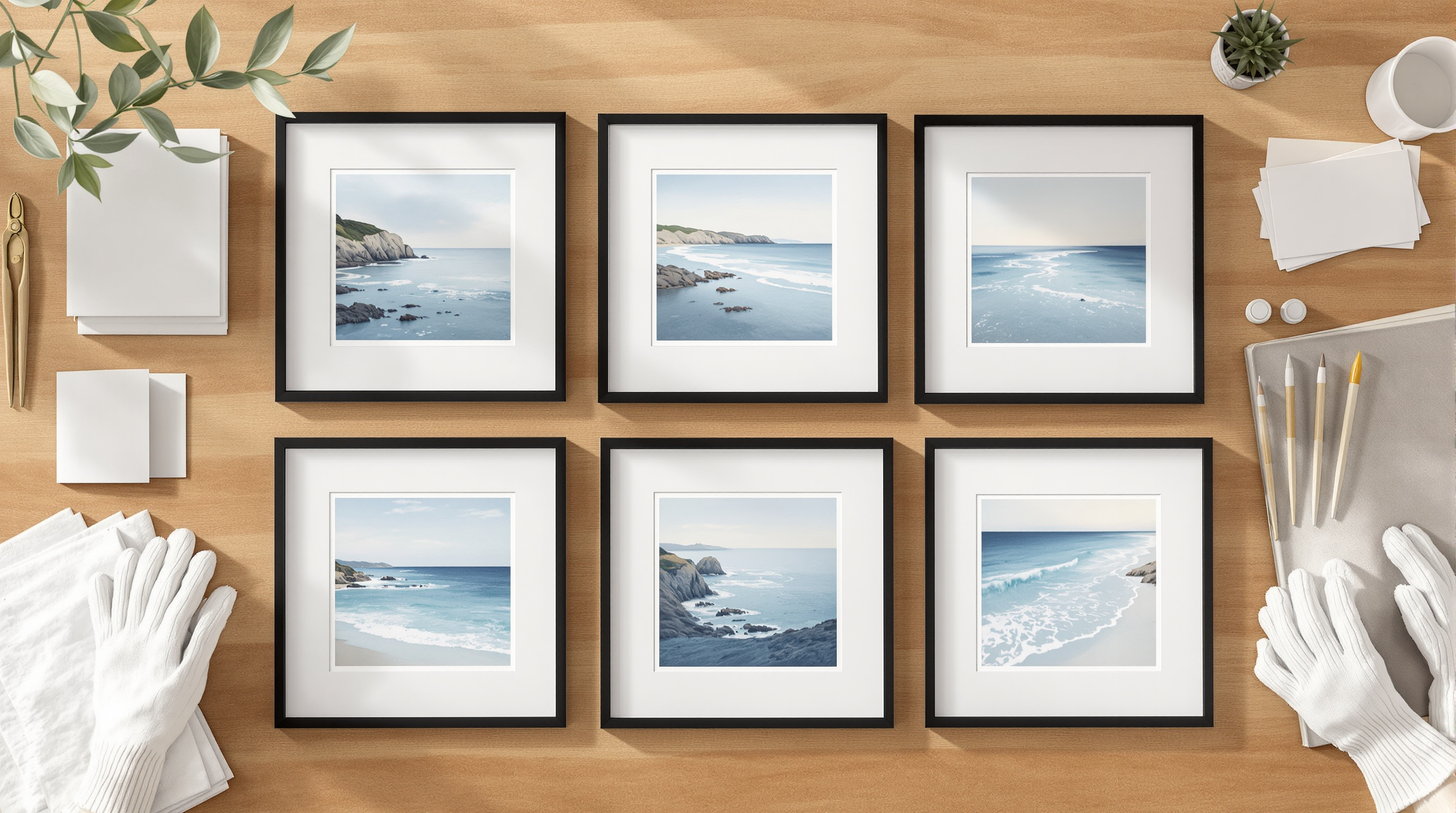
The Art Card: Smallest Honest Format
The five-by-seven art card is the Northwest gallery's handshake — a real reproduction on decent stock, sold for the price of a coffee, equally at home in an envelope or a small frame. Cards built the audience for coastal art: a visitor who mailed six cards home had hung the artist's work in six houses. Collectors underrate them. A complete run of an artist's cards is a miniature retrospective, easy to store and increasingly hard to assemble once a print shop closes.
Open Editions: The Workhorse Print
An open edition print is reproduced without a promised limit — printed as demand asks, often across decades. "Frameable" in the old catalogues meant exactly what it said: a standard size (8x10, 11x17) that drops into an off-the-shelf frame without custom cutting. Open editions are not investments and were never meant to be; they are how a working image earns its living. Judge them on printing quality — clean blacks, no banding, faithful colour — and on paper weight. A good open edition on heavy stock outlives a careless limited edition every time.
Limited Editions: What the Numbers Promise
A limited edition is a contract. The fraction in the margin — 47/250 — promises that the publisher will print 250 and no more, and the artist's pencil signature converts the sheet from reproduction to artwork. The contract is only as good as its keeper, so the conventions matter:
- Edition size. Smaller is scarcer, but 250-500 was the honest standard for regional work; suspiciously tiny editions sometimes hide multiple "states" of the same image.
- Proofs. Artist's proofs (A/P) and printer's proofs exist outside the numbered run and traditionally amount to about ten percent of it.
- Signature and title in pencil. Pencil cannot be printed convincingly; it remains the field mark of a genuine signed sheet.
The print trade's full vocabulary — states, proofs, processes — is well documented by the International Fine Print Dealers Association, and their glossary is worth twenty minutes of any new collector's time. For the deeper history of printmaking as an art form, the Metropolitan Museum's drawings and prints department is the great open classroom.
Framing Without Regret
Two rules recover most framing mistakes before they happen. First, never trim a print to fit a frame — value lives in the margins, where the numbering and signature sit. Second, insist on acid-free matting and backing; the rust-coloured burn of acidic mats is the most common damage in the resale market and is entirely preventable. UV-filtering glass costs a little more and earns it within a decade on any wall that sees daylight.
Buying Editioned Coastal Art Today
Editioned prints from the small coastal publishers of the 1990s and 2000s now circulate through estate sales, marine swap meets, and regional auctions. Condition and completeness rule: margins intact, numbering legible, no mat burn. Pair this page with the originals primer to understand the whole ladder, then walk the galleries to learn the images themselves — the only knowledge that makes any catalogue, old or new, mean something.