Bute Inlet: Painting the Long Fjord
Bute Inlet does not photograph well, which is exactly why painters love it. The fjord runs some eighty kilometres into the Coast Mountains north of Campbell River, walled by granite that climbs straight from tidewater toward peaks above three thousand metres, and floored by water the colour of milky jade — glacial flour from the Homathko and Southgate rivers, held in suspension like pigment that never settles. A camera flattens all that into postcard improbability. A painter, choosing and exaggerating honestly, can make you feel the scale in your knees.
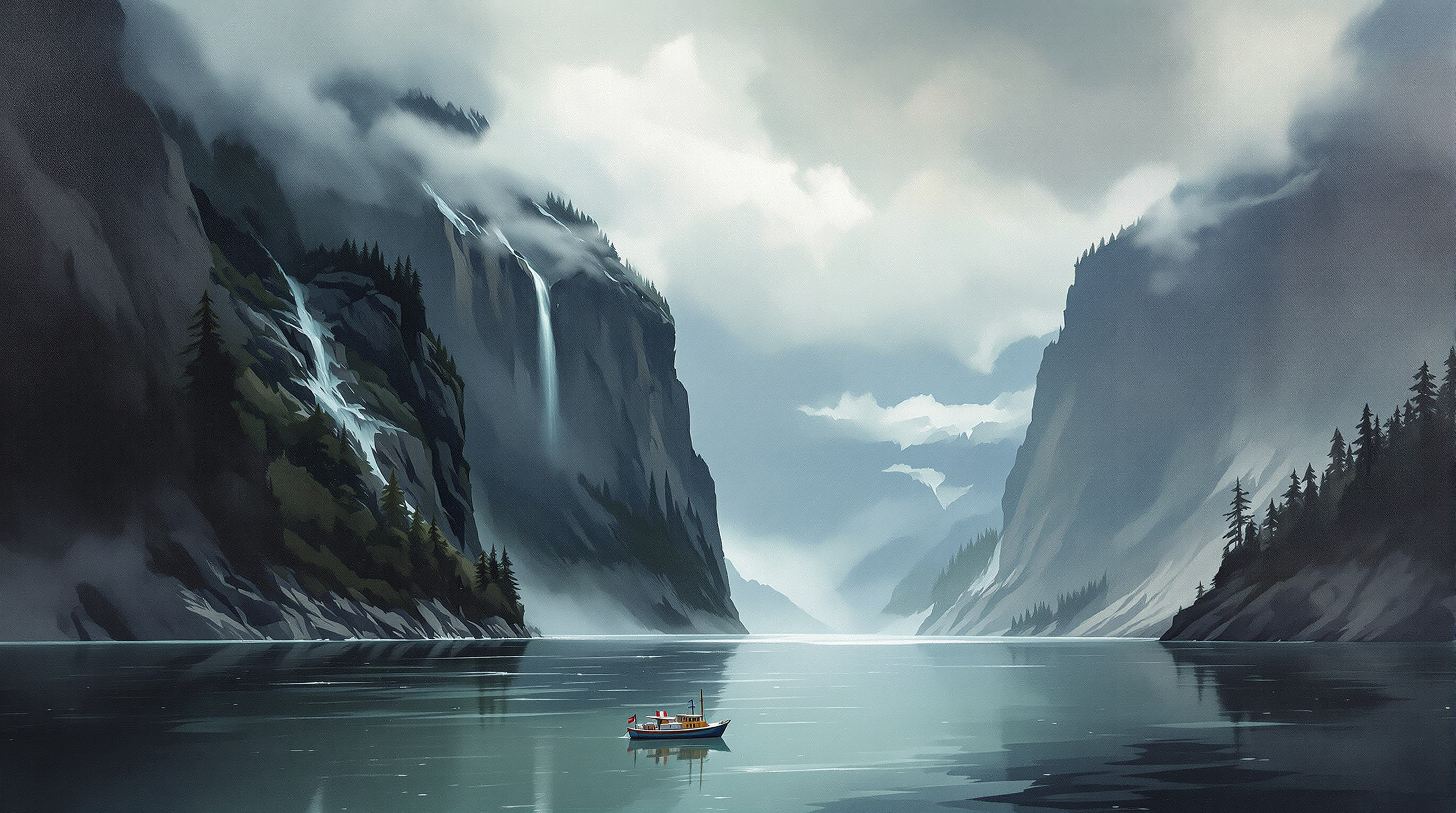
The Geography of the Subject
Bute is one of the great fjords of the British Columbia mainland — a glacier-cut trench whose walls continue underwater nearly as steeply as above it. Weather stacks in it: the inlet brews its own winds, the infamous Bute outflows that pour cold off the icefields in winter and flatten the sea white. Mount Waddington — the highest peak entirely within BC — anchors the range at the inlet's head, a summit with its own place in the old galleries' titles. The province's geographic data catalogues render the inlet as clean blue geometry; standing in it, painters report, feels more like being swallowed.
How Painters Solve It
The fjord presents a technical riddle: everything is vertical, but canvases are horizontal. The classic solutions recur across decades of coastal painting:
- The witness boat. A gillnetter or tug, tiny against the lowest hundred metres of wall, gives the eye a unit of measure. Without it the granite reads as cliff; with it, as cathedral.
- The stacked atmosphere. Bute's walls disappear into weather more days than not. Painting the cloud ceiling honestly — a hard line at four hundred metres, summits implied, not shown — conveys more height than any clear-day rendering.
- The jade water. That improbable green-white sea is the inlet's signature, and timid painters kill it by greying it down. The honest colour looks invented; the courage to paint it anyway is the test of the subject.
A Worked Coast, Thinly
Bute has never held towns, but it has always held work — handloggers' camps, a cannery era at its mouth, and lately the floats and tenders of an aquaculture industry. The human traces are sparse enough that each one carries weight in a composition: a boom of logs in a bight, a camp light under a black wall at dusk. Painters of the working-coast school treat the inlet as their genre at its outer limit — the place where the partnership of boat and water plays out against indifference on a geological scale. Estuaries at the river mouths, among the most productive grizzly habitat on the south coast, link the fjord to the wildlife painting tradition as well.
Standing Before a Bute Canvas
Judge a painting of this inlet by its restraint. The subject hands the painter a melodrama — mile-high walls, jade sea, hanging ice — and the temptation is to play every note at once. The canvases that last choose one fact and honour it: the weight of the cloud ceiling, the smallness of the boat, the wrongness of the water's colour. Pair this essay with its sister portrait of the Skeena River, the other named landscape these galleries kept returning to, or step back to the working coast overview.