The Working Coast: Boats, Tugs & Canneries in Paint
Ask a gallery owner anywhere between Victoria and Prince Rupert what sells year after year, and the answer is rarely a sunset. It is a boat — and not a yacht. The defining subjects of British Columbia coastal art are working vessels: gillnetters with their drums and davits, seiners stacked with net, tugs leaning into a tow, the squat dignity of a pilot boat in a lumpy channel. This page is a guide to that genre — where it came from, what its painters get right, and why a picture of a rusting troller can hold a wall better than any postcard view.
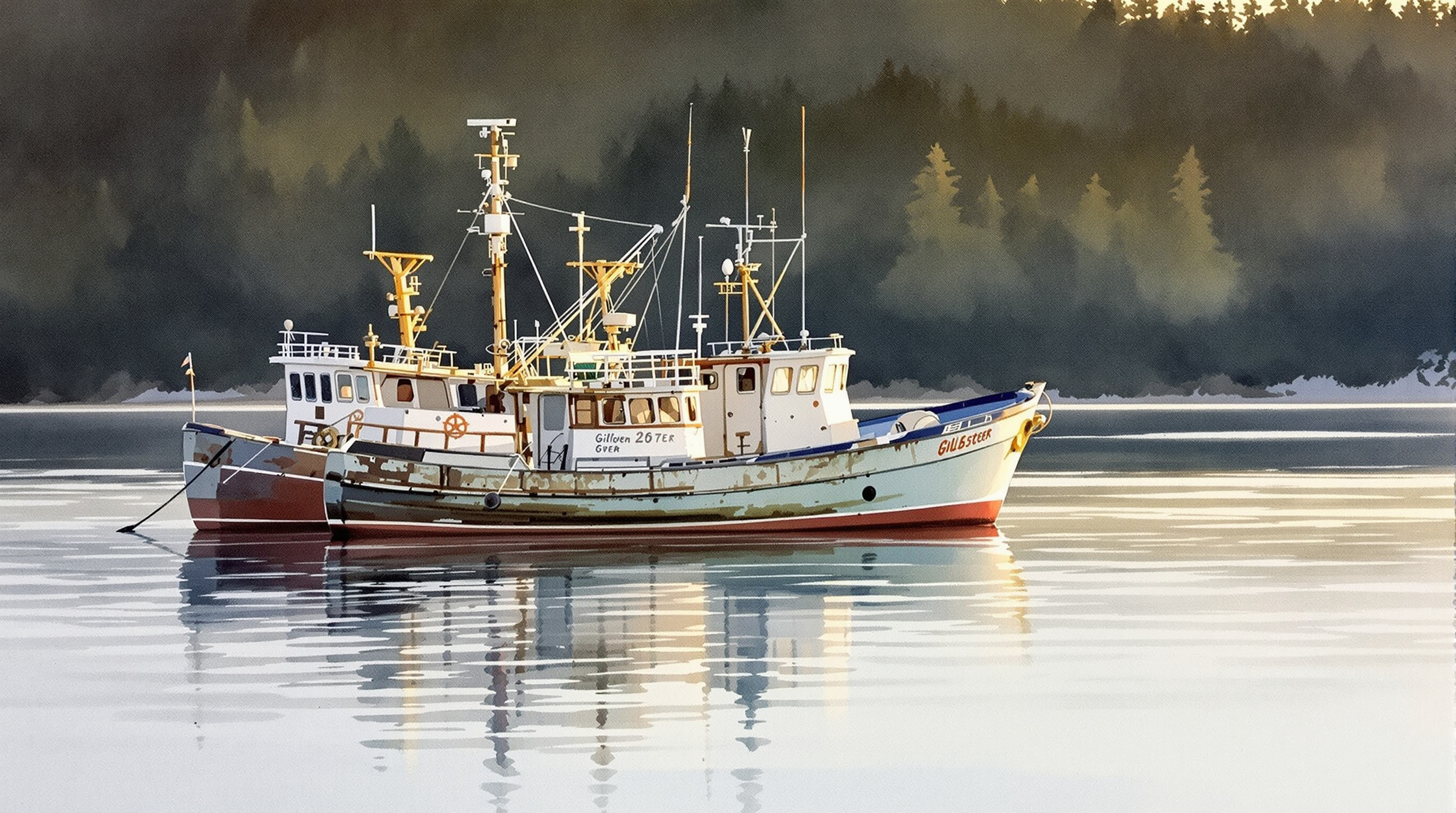
Why Working Boats Became the Coast's Portrait
For most of the twentieth century, the BC coast ran on fish and timber. Every inlet with a creek mouth had a cannery; every cannery had a fleet. When painters of the era looked for the coast's character, they found it in those hulls — each one modified, patched, and renamed until it was as individual as a face. Marine historians estimate that more than two hundred salmon canneries operated on this coast at the industry's peak, and institutions like the Gulf of Georgia Cannery National Historic Site preserve what the paintings remember: net lofts, boardwalks, and the long cannery rows that gave so many canvases their title.
The genre has its own conventions. The boat is almost never racing; it is waiting, working, or coming home. Weather does the emotional labour — a high overcast for patience, a southeaster for trouble. And the human figure, when it appears at all, is small and busy, because the subject is the partnership between hull and water, not the portrait of any one deckhand.
The Classic Subjects
Certain compositions recur so often they amount to a shared songbook. Collectors will recognize most of these at fifty paces:
- Gillnetters at anchor — usually at dusk, rafted two or three together in a place like Smith Sound, mast lights just coming on.
- The tug and tow — an old steam or diesel tug pulling a log boom or rail barge, stack smoke flattened by wind.
- Cannery row — pilings, corrugated roofs, and the green-grey water of a river mouth; the Skeena and the Fraser supplied most of the models.
- The old friend ashore — a retired hull hauled out in the grass, half story and half elegy.
- Ferries and coastal freighters — the workhorses that stitched the outports together before highways and airstrips.
Reading a Working-Coast Painting
Good marine painters are sticklers, and their audiences are worse. A gillnetter's drum sits aft; a troller's poles rake forward at rest. Rigging that could never function is the fastest way for a painting to die in a coastal gallery, because half the people walking in have stood on those decks. When you assess a work in this genre, look at three things: the waterline (a loaded hull sits differently than a light one), the light on the wheelhouse (the coast's overcast produces soft, directional grey-blue light, almost never hard shadow), and the tide line on the pilings (painters who know the coast paint the barnacle band).
The Vancouver Maritime Museum is the best single place to calibrate your eye — its collection puts paintings, models, and the real artifacts side by side.
The Painter's Debt to the Shipwrights
A working-coast painting is only as honest as the vessel underneath it, and the vessels themselves were regional documents. A Fraser River gillnetter, a West Coast troller, a Gulf of Georgia seiner — each hull answered a particular fishery, a particular weather, a particular set of shipwrights working from patterns carried in their heads rather than on paper. When a painter renders a boat correctly, they are preserving naval architecture that was often never formally drawn. Maritime museums have come to value marine art partly for this reason: a careful canvas can record a vanished hull form more completely than the sparse paper trail ever did. The Maritime Museum of British Columbia in Victoria keeps both the models and the paintings, and the quiet conversation between them is where a collector's eye is really trained.
Where the Genre Stands Now
The working coast that built this genre has thinned: fleets consolidated, canneries closed, tugs grew containerized and anonymous. That loss is exactly what keeps the paintings vital. A canvas of gillnetters at dusk is no longer a scene report; it is testimony. The painters still working this vein are, knowingly or not, history painters now — and the best of them treat the subject with a historian's care and a deckhand's affection.
Continue into the wildlife gallery, or jump ahead to village and heritage scenes. If a painting on this theme has already found you, our collector's guide explains the difference between the card, the open print, and the limited edition before you frame it.