The Skeena: Painting the River of Mists
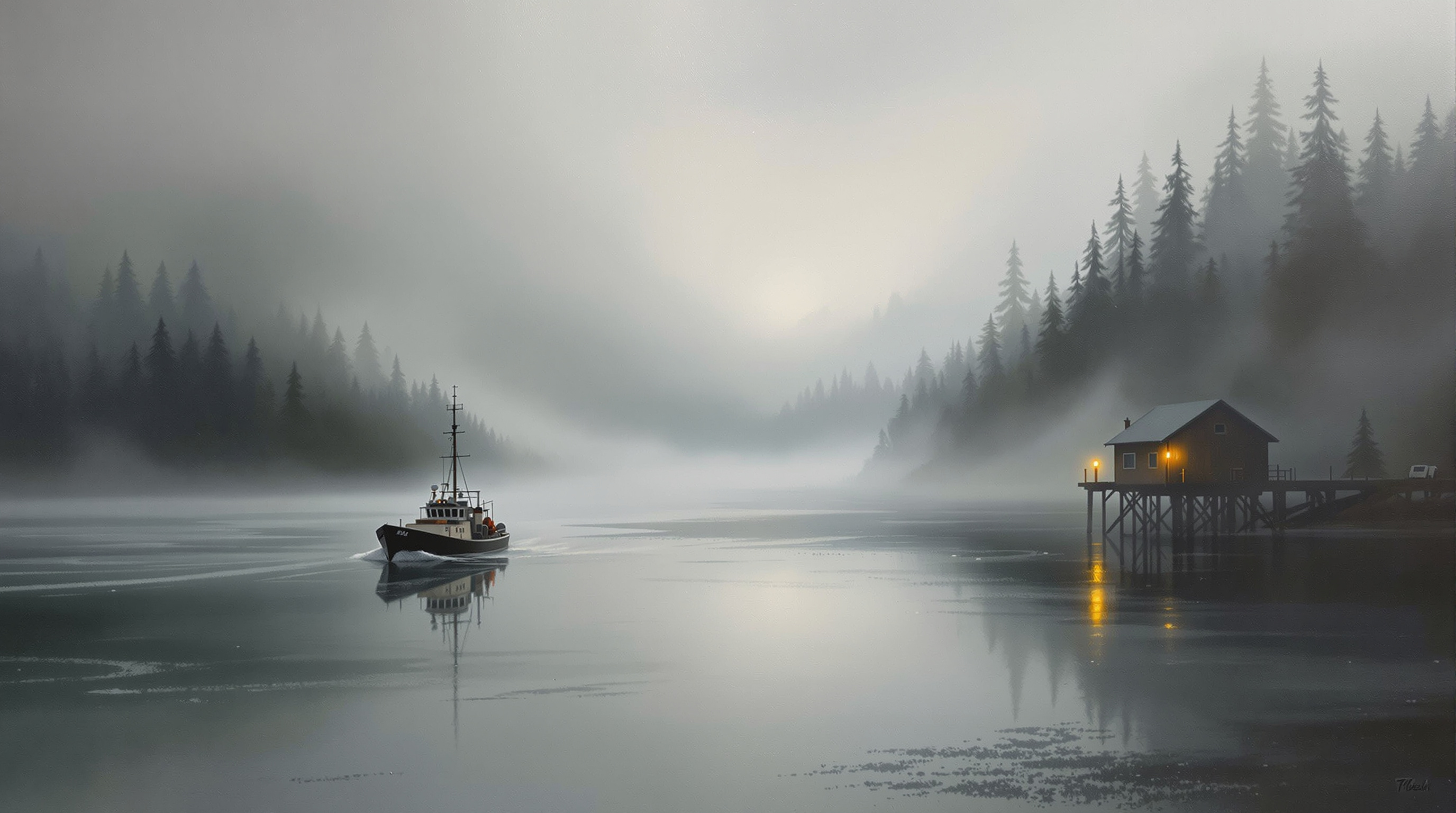
The Skeena enters the sea wide, grey-green, and authoritative — the second-longest river entirely within British Columbia, draining a watershed the size of a small country and carrying, in season, one of the great wild salmon migrations left on earth. Its name is commonly rendered from the Tsimshian as "river of mists," and the mists are not a poetic flourish; they are the working condition. Painters who take on the Skeena learn to compose in three or four values of silver, and the ones who succeed produce some of the most atmospheric work in the entire coastal genre.
A River That Built a Coast
For the Tsimshian, Gitxsan, and Wet'suwet'en nations, the Skeena has been highway, larder, and homeland for thousands of years; the river's human history is theirs first, and its cultural sites and stories remain living property, not free material. The industrial chapter came fast and loud: between the 1870s and the 1950s the lower river and its approaches held dozens of salmon canneries, and the river mouth ran like a seasonal city. That world is documented superbly at the North Pacific Cannery National Historic Site near Port Edward — the oldest surviving cannery village on the coast and an unmatched reference for any painter or collector of the cannery-row genre.
The Salmon Engine
Everything in a Skeena composition ultimately answers to the fish. The river's sockeye, pink, coho, chinook, and steelhead runs set the calendar for every cannery, gillnetter, eagle, and bear that the genre paints. Conservation science treats the watershed as a benchmark for wild salmon production — the Pacific Salmon Foundation publishes accessible assessments of its runs — and the painting tradition, knowingly or not, is a visual archive of that abundance: drum-loaded gillnetters working the tide, canneries lit at two in the morning, bears stationed at the canyon riffles upstream.
Painting in Four Values of Silver
The Skeena's light is its technical signature. Coastal overcast plus river mist produces a compressed value range — no true black, no clean white, everything negotiated in silvers — and the genre's best river canvases accept the constraint rather than fighting it:
- The held horizon. Where water ends and mist begins is a decision, not an observation; strong Skeena paintings place that line deliberately and let it carry the composition.
- Warm interruptions. A cannery lamp, a hull's rust streak, a cedar's red underbark — one warm note in the silver does the work of a whole palette elsewhere.
- Moving water, still air. The river's surface texture against the mist's blankness is the subject's fundamental contrast; painters who render both as soft lose the river entirely.
The Skeena Canvas as Document
Because so much of the river's industrial world is gone — canneries collapsed to pilings, fleets a fraction of their size — Skeena paintings now do double duty as art and record, the same work the village and heritage gallery describes for the coast at large. When you stand before one, read it twice: once for the silver atmosphere, once for the documentary freight. The strongest examples carry both without strain. Its sister essay on Bute Inlet shows the genre solving the opposite problem — vertical granite instead of horizontal mist — and the working coast overview places both rivers in the larger tradition.