Charts & Field Studies: The Art of the Species Chart
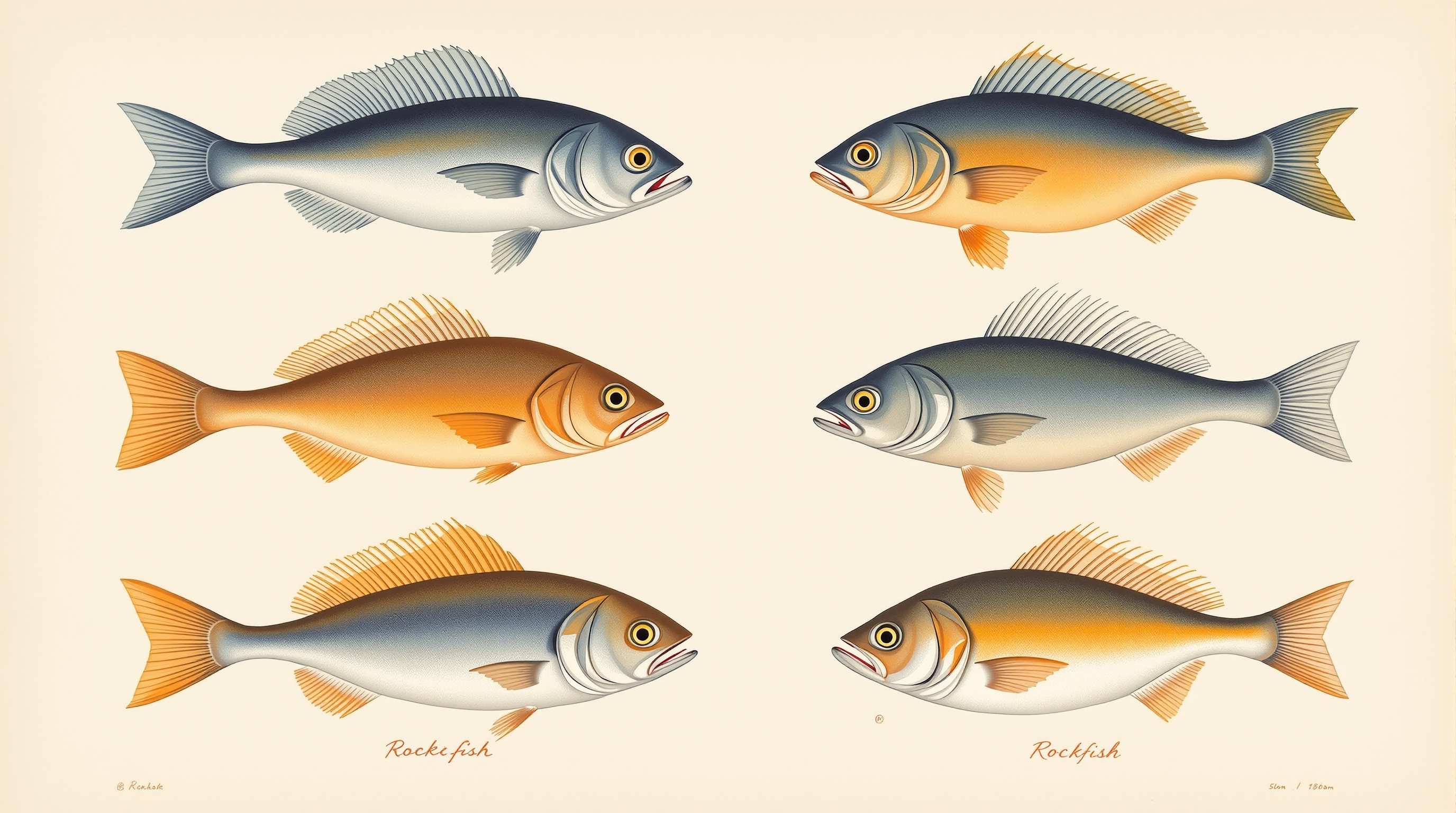
Somewhere between the field guide and the framed landscape lives a form the Northwest coast can fairly call its own: the species chart. One sheet, one family of creatures — every rockfish of the reef, every age class of the bald eagle, the prawns and crabs of the inlet floor — drawn true to science and arranged with a designer's eye, meant equally for the galley bulkhead and the kitchen wall. The old coastal print shops sold eagle charts, bear charts, quillback charts, and prawn charts alongside their sunsets, and the form deserves this page of its own.
Where the Chart Comes From
The species chart's grandparents are the plates of the great natural-history illustrators — Audubon's birds, the fish lithographs of the nineteenth-century survey expeditions. Scientific illustration has always done something photography cannot: it shows the typical specimen rather than a particular one, lit evenly, posed for comparison. You can see the standard set by the U.S. government's own scientific illustrators in the U.S. Fish & Wildlife Service's media library, and the tradition runs unbroken from those plates to the laminated salmon chart on a charter boat's cabin wall.
What Makes a Good One
A chart succeeds or fails on three disciplines:
- Comparative accuracy. The point of a rockfish chart is the differences — the quillback's spines, the copper's pale lateral blaze, the yelloweye's colour that earns its name. Fisheries biologists keep the canonical references; Fisheries and Oceans Canada's species identification pages are the measuring stick a Pacific chart must meet.
- Even staging. Every specimen faces the same way, at the same scale logic, under the same flat light. The chart is a census, not a drama.
- Designed restraint. Labels in a quiet hand, a title that states the family and the place, and margins generous enough that the sheet reads as art. The best charts are beautiful precisely because they refuse decoration.
The Chart as Coastal Furniture
Part of the form's charm is where it lives. Charts get tacked up in net sheds, screwed to galley bulkheads, hung in the mudroom where the field guide would get soaked. They are working art — consulted, argued over, pointed at with a filleting knife. A chart that has spent ten years aboard a troller, fish-blooded and sun-faded, has acquired a provenance no gallery can sell you. New collectors should buy two: one to frame and one to use.
Collecting Charts Today
Vintage Northwest species charts surface at marine swap meets, estate sales in fishing towns, and the back rooms of coastal galleries. Condition matters less than completeness — a faded chart with all its margins beats a bright one trimmed to the image. And because charts were usually sold as open-edition prints and cards, prices stay friendly; this is the most affordable door into coastal art collecting. Our collector's guide to cards and editions covers the formats these sheets were issued in, and the wildlife gallery shows what happens when the same animals escape the grid and get a whole canvas to themselves.
A Note on Bird Charts
The eagle chart deserves its own footnote. Unlike fish charts, which compare species, the classic eagle chart compares ages — the same bird, year over year, from the dark juvenile through the piebald adolescent to the white-headed adult. It is a biography in six portraits, and it quietly teaches the chart's deepest lesson: identification is a form of attention, and attention, sustained long enough, becomes affection. Most coastal kids learned their first bird from a chart like this, taped to a cabin wall a long row from town.